


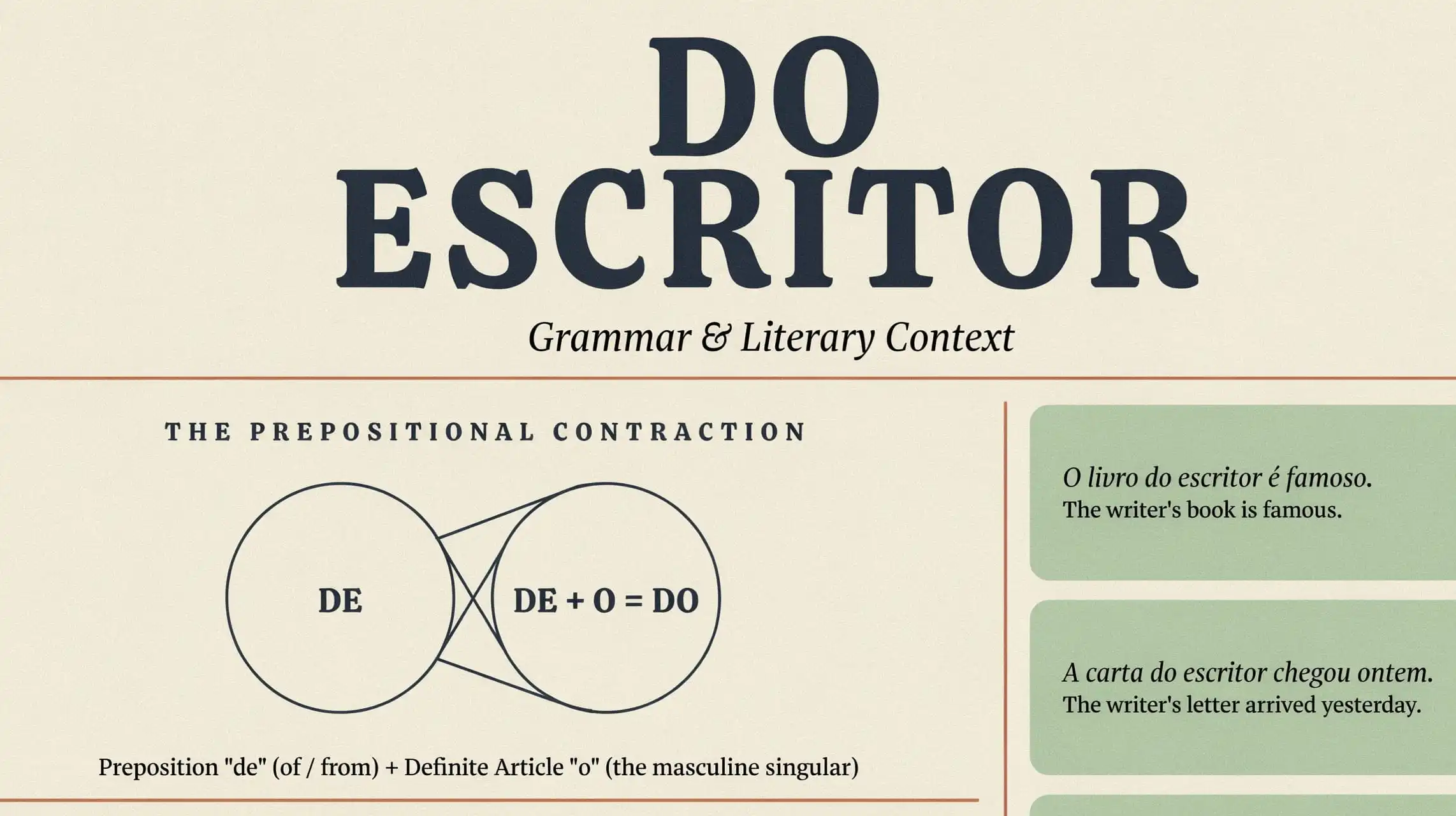
Language often contains small phrases that carry deeper meanings than they appear to have at first glance. One such phrase is do escritor. Many people encounter this expression while reading Portuguese books, studying the language, or searching online for its meaning. Although it consists of only two words, it provides an excellent example of how Portuguese grammar works and how ownership or connection is expressed.
Understanding do escritor helps language learners improve their Portuguese skills while also gaining insight into Portuguese-speaking cultures. This phrase appears in literature, academic discussions, language lessons, and everyday communication. Learning its meaning and structure can make reading Portuguese texts much easier.
What Does Do Escritor Mean?
The phrase do escritor translates into English as “of the writer” or “the writer’s.” It is used to show that something belongs to, is connected to, or is associated with a writer.
For example, if someone says “o estilo do escritor,” they are referring to the writer’s style. Likewise, “a voz do escritor” means the voice of the writer. In both examples, the phrase connects an idea directly to the author. Rather than standing alone, it usually appears with another noun that identifies what belongs to the writer or what is related to them.
This simple meaning forms the foundation for understanding how possession works in Portuguese.
How the Phrase Is Formed
To understand the phrase fully, it helps to examine its two parts.
The word “do” is actually a contraction. It combines the Portuguese preposition “de” (of) and the article “o” (the). Instead of writing the two words separately, Portuguese grammar joins them into a single word.
The second word, “escritor,” means writer or author. It refers to a person who creates written works such as books, articles, essays, stories, or poems.
When these two words come together, they create a possessive expression that functions similarly to the apostrophe structure used in English. This grammatical feature appears throughout the Portuguese language and is considered a basic yet important rule.
Understanding Possession in Portuguese
One reason language learners find Portuguese interesting is its approach to possession. English commonly uses an apostrophe and the letter “s” to show ownership. Portuguese takes a different route.
Instead of saying “the writer’s book,” Portuguese uses a structure that literally means “the book of the writer.” The phrase becomes “o livro do escritor.”
At first, this structure may seem unusual to English speakers. However, after seeing it repeatedly in books, articles, and conversations, it becomes natural. Portuguese relies heavily on prepositions and contractions to express relationships between people, objects, and ideas.
This system creates smooth and elegant sentences while maintaining grammatical clarity.
Where You Can See Do Escritor Used
The phrase appears in many different contexts. Literature is one of the most common places where it can be found. Literary critics often discuss an author’s style, influence, voice, and legacy using expressions connected to writers.
Academic papers also use the phrase when analyzing books, essays, and historical texts. Students studying Portuguese literature frequently encounter it during research and coursework.
Beyond academia, blogs, educational websites, and language-learning resources regularly use examples involving writers because they clearly demonstrate Portuguese grammar. This widespread usage helps learners become familiar with the phrase quickly.
The phrase remains relevant because writing continues to play an important role in communication and culture.
The Role of Writers in Portuguese Culture
The importance of writers extends far beyond grammar. Throughout Portuguese-speaking countries, writers have played a significant role in shaping national identity and cultural heritage.
Portugal and Brazil have produced many celebrated literary figures whose works continue to influence readers worldwide. Their contributions have preserved history, explored human experiences, and reflected social change.
When people refer to ideas connected to a writer, they often use expressions involving do escritor. These references highlight respect for creativity, knowledge, and intellectual achievement.
The phrase therefore carries both grammatical and cultural significance, linking language with centuries of literary tradition.
Gender Variations in Portuguese
Portuguese nouns generally have grammatical gender. This affects how possessive expressions are formed.
The word “escritor” refers to a male writer. When discussing a female writer, Portuguese uses the word “escritora.” As a result, the phrase changes as well.
Instead of “do escritor,” Portuguese uses “da escritora.” Here, “da” is formed from the combination of “de” and “a,” with “a” being the feminine article.
This pattern appears throughout the language and helps speakers identify gender naturally. Learning these variations is an important step toward mastering Portuguese grammar and understanding authentic texts.
Similar Phrases That Follow the Same Pattern
Once learners understand this structure, many other Portuguese expressions become easier to recognize.
Examples include:
- Do autor – Of the author
- Da autora – Of the female author
- Do poeta – Of the poet
- Da poetisa – Of the female poet
- Dos escritores – Of the writers
Each phrase follows the same grammatical principle. The article changes according to gender and number, while the overall structure remains consistent.
Studying these examples strengthens comprehension and builds confidence when reading Portuguese materials.
Why Language Learners Study This Phrase
Language teachers frequently use do escritor when explaining contractions and possession. It provides a simple and practical example that students can remember easily.
Many learners first encounter the phrase while reading Portuguese texts or translating passages into English. Because the phrase appears often in educational materials, it becomes one of the early examples students learn.
Understanding it helps learners recognize similar constructions throughout the language. As a result, they gain a better grasp of sentence structure, grammar rules, and reading comprehension.
Mastering small phrases like this often leads to greater confidence in overall language learning.
The Connection Between Language and Identity
Words and phrases do more than communicate information. They also preserve history, values, and identity. Portuguese contains many expressions that reflect cultural traditions and ways of thinking.
The phrase associated with a writer reminds readers that every piece of writing comes from a unique individual with personal experiences and ideas. Whether discussing novels, essays, poetry, or journalism, the connection between creator and creation remains important.
Language allows people to acknowledge these connections clearly. This is one reason why grammatical structures like this continue to hold value across generations.
Why Do Escritor Remains Relevant Today
Modern communication has changed dramatically through technology, social media, and digital publishing. Despite these changes, writers continue to influence society.
Books, blogs, online articles, and educational resources all depend on writers to share knowledge and ideas. Because of this, phrases connected to authors remain common in contemporary Portuguese.
Whether someone is reading literature, studying grammar, or exploring cultural topics, they are likely to encounter this expression repeatedly. Its continued relevance shows how language evolves while preserving its traditional foundations.
For learners, understanding these common structures opens the door to more advanced reading and communication skills.
Conclusion
The phrase do escritor may appear simple, but it offers valuable insight into Portuguese grammar, culture, and communication. It translates to “of the writer” or “the writer’s” and demonstrates how Portuguese expresses possession through contractions rather than apostrophes.
Beyond grammar, the phrase reflects the importance of writers within Portuguese-speaking societies. It connects readers to literature, cultural heritage, and the individuals behind creative works.
Whether you are studying Portuguese, reading literature, or simply exploring a new language, understanding this expression provides a useful foundation. Small phrases often reveal the most interesting aspects of a language, and this one is no exception.
FAQs
1. What does do escritor mean in English?
It means “of the writer” or “the writer’s” and is used to show ownership or connection.
2. Is do escritor a complete sentence?
No. It is a phrase that usually appears with another noun in a sentence.
3. What does the word escritor mean?
Escritor means writer or author in Portuguese.
4. How is the word do formed?
It is a contraction of “de” (of) and “o” (the).
5. What is the feminine version of do escritor?
The feminine version is “da escritora,” meaning “of the female writer.”
6. Is this phrase commonly used in Portuguese?
Yes. It appears in literature, education, academic writing, and everyday communication.
7. Why is do escritor important for learners?
It helps learners understand possession and contractions in Portuguese grammar.
8. Can the phrase be used in book discussions?
Yes. It is often used when discussing a writer’s style, ideas, or literary works.
9. Does Portuguese always use contractions like do?
Portuguese frequently uses contractions, especially with common prepositions and articles.
10. Is do escritor still relevant today?
Yes. Writers remain important in modern communication, making the phrase useful in both traditional and digital contexts.
